
AI agents · Automation · Architecture
AI agent or regular automation? How we decide
Not every workflow needs an AI agent. A practical guide to choosing between fixed automation, an LLM step inside a workflow, and a full agent — and how to keep each one safe.
By the CognifySystems engineering team · · 5 min read
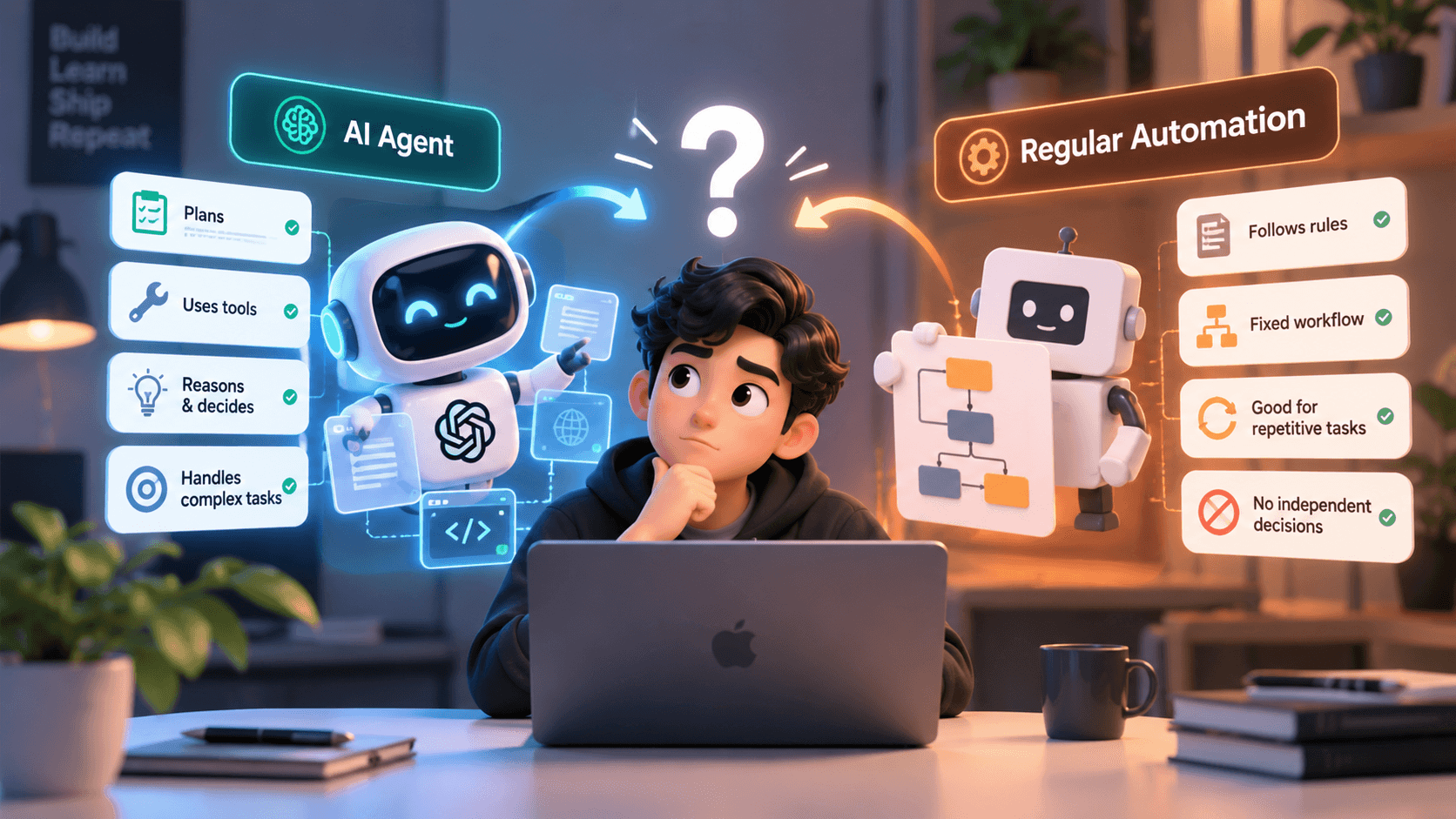
Three options, not two
When a team asks us for “an AI agent”, the first question we ask is what the work actually looks like. There are really three options, and they get more flexible — and harder to make reliable — in this order:
- Fixed automation: the same steps every time. If X happens, do Y. No AI needed.
- A workflow with an LLM step: the steps are fixed, but one step needs reading or judgement — classify this email, extract fields from this invoice, draft a reply.
- An agent: the model decides which steps to take, which tools to call and in what order, until the task is done.
Questions that decide it
- Are the steps the same every time? Then use fixed automation.
- Is the input messy (free text, documents, emails) but the process fixed? Use a workflow with one or two LLM steps.
- Does the path depend on what is found along the way — searching, checking, deciding what to look at next? That is where an agent earns its cost.
- What happens when it is wrong? The higher the cost of a mistake, the more you want fixed steps and human approval around the AI.
- Can you test it? Fixed steps are easy to test. Agents need evaluation sets and logs to understand their behaviour.
Most good systems are mostly workflow
In practice the best design is usually a fixed workflow with AI only where judgement is needed, and an agent only for the genuinely open-ended part. It is cheaper to run, easier to test, and when something breaks you can see exactly which step failed.
Our AI Prompt Compiler follows this shape: a fixed sequence of stages (classify the intent, analyse it, choose a strategy) with multi-agent orchestration only in the stage where several specialised agents work in parallel and a manager agent consolidates their output.
Keeping an agent safe
- Give it the smallest set of tools that can do the job.
- Validate every tool input and output against a schema.
- Require human approval before irreversible or high-stakes actions — sending, paying, deleting.
- Log every step: what the model saw, decided and called, so you can audit it.
- Set limits on steps, time and cost, and fail safely — hand off to a person rather than guess.
- Keep a fallback model or provider so one outage doesn't stop the system.
A simple starting point
If you are unsure, start with the workflow-plus-LLM-step version. It solves most real business problems, it is easy to measure, and if it turns out the path really does need to be dynamic, the same building blocks — tools, validation, logs — carry straight over into an agent.